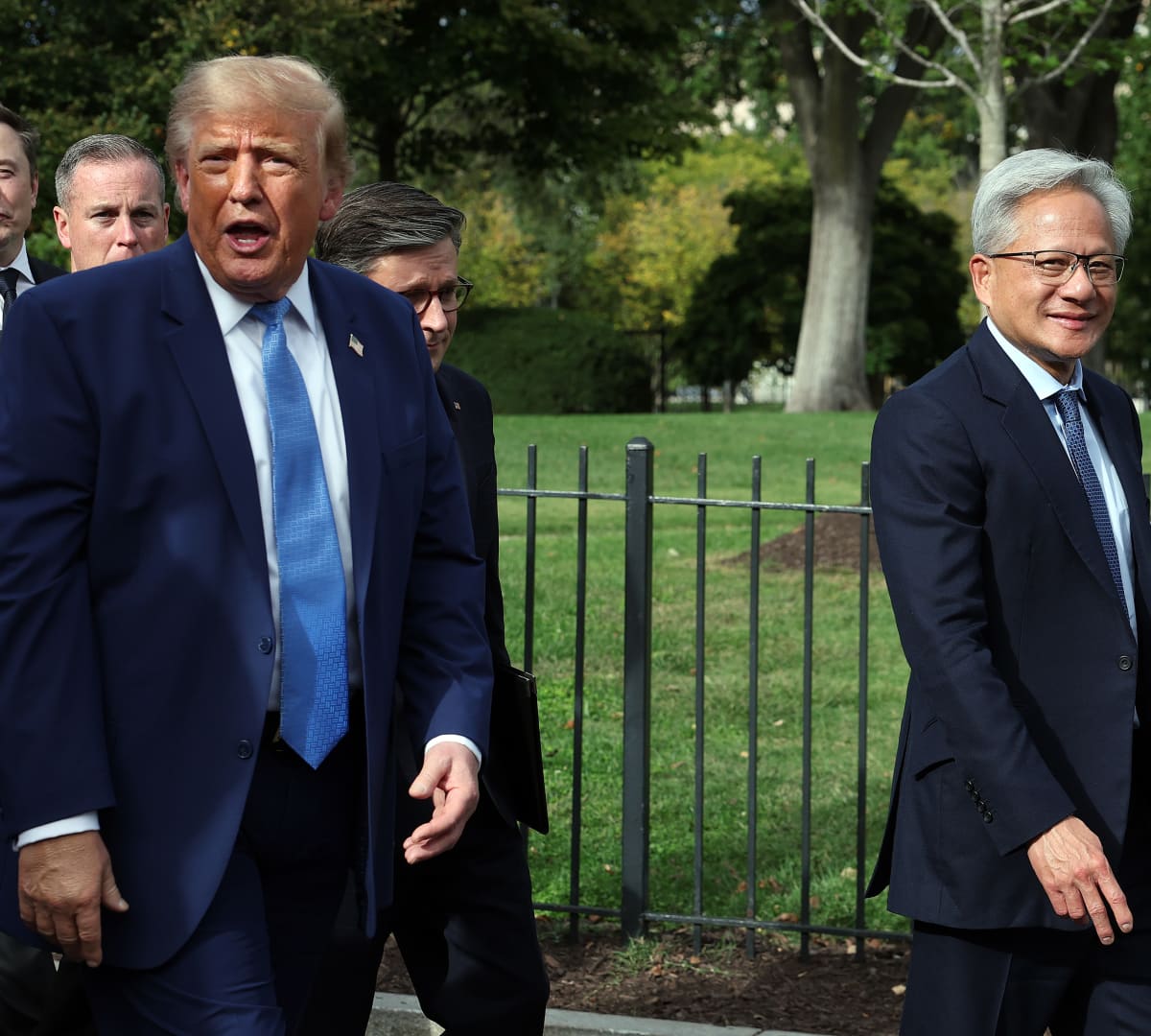
Donald Trump has every reason to like Nvidia's rise, and that is exactly why his financial disclosures deserve harder scrutiny than a shrug from the White House. According to a CNBC analysis of his annual and periodic filings, his investment accounts have bought or sold Nvidia shares at least 103 times since he returned to office, in transactions worth a combined $27 million to $97.5 million. Nvidia became one of his three largest individual holdings by the end of last year.
The timing is what should trouble anyone who cares about public trust. The report says Trump's accounts sold between $500,001 and $1 million in Nvidia on May 18, the first Monday after he returned from a state visit to China with Jensen Huang. Five days earlier, the Times reported, Secretary of State Marco Rubio had briefed Trump on intelligence about Huang's relationship with a woman suspected of spying for China. Trump said on Monday, "I haven't heard that," and the report notes that the disclosures offer no evidence he directed the trades or that his advisors had access to classified intelligence. Those are fair limits on what can be proven. They are not a reason to stop asking questions.
The defense offered by the White House and the Trump Organization is that independent advisors manage the portfolio without the president's input, a setup meant to "avoid even the appearance of a conflict of interest." That arrangement is only as credible as the rules that enforce it. A portfolio of more than 21,000 trades in 2025 alone, compared with roughly 500 in his entire first term, is not the profile of a passive investor. When a president's holdings move in step with decisions about a company's access to China, the appearance problem is already present, whatever the managers intended.
What should happen next is straightforward. Disclosure should require enough detail to show share counts rather than broad dollar ranges, so the public can see what the president holds at any moment. Officials with access to sensitive intelligence should be barred from any trading in companies whose policy outcomes they influence. Congress should decide whether the current advisor-managed model, operating at this volume, meets the standard Trump's own spokespeople claim for it.
Nvidia's chips are not a private matter when the government is deciding whether they reach China and on what terms. The president's accounts should not be able to profit from those decisions with a blind trust that is blind only on paper.